.webp)
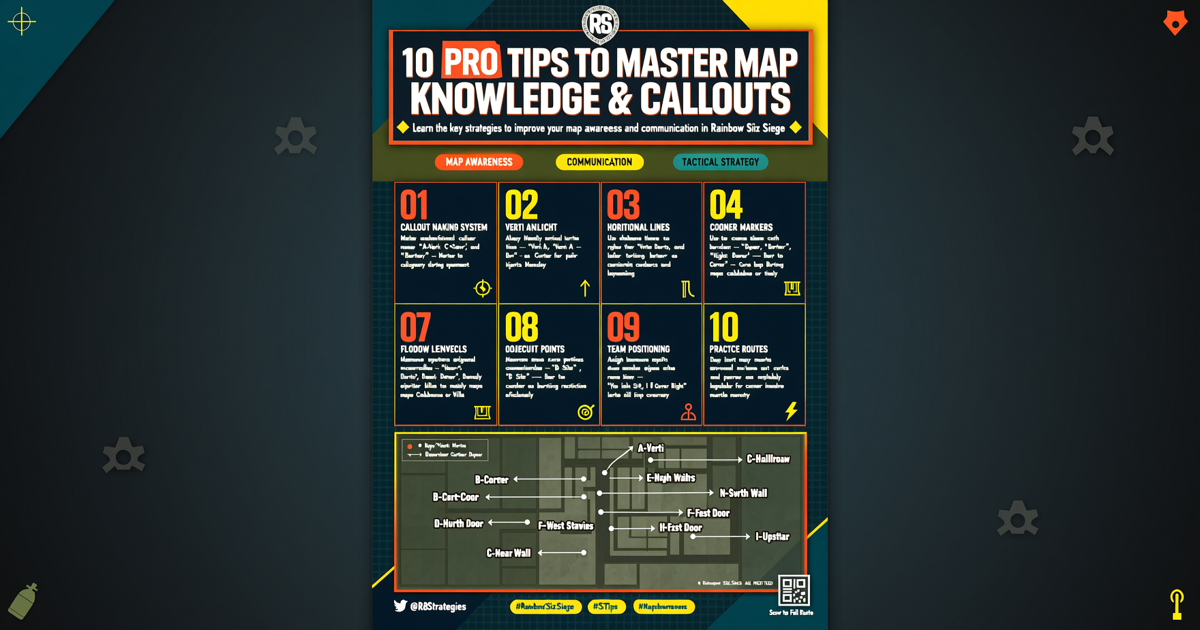
10 Pro Tips to Master Map Knowledge and Callouts in Rainbow Six Siege
Introduction
In Rainbow Six Siege, map knowledge and effective callouts are the foundations of victory. Whether you're a bronze or a plat, knowing the layout, the room names, and how to communicate them can turn the tide of any round. Here are 10 pro tips to elevate your game.
1. Learn the Default Room Names

Every map has specific room callouts used by the community. Spend time in custom games running through each map and memorizing the names displayed on the HUD. For example, on Oregon, the basement is "Laundry" and "Supply Room." Using correct names reduces confusion and speeds up team reactions.
2. Practice Drone Phase Routes
During the prep phase, drive your drone through common paths used by attackers. Note spawn peeks, rotation holes, and hiding spots. This knowledge lets you anticipate enemy movements and call out early intel. Save one drone for later use—hide it in a strategic spot.
3. Use Vertical Play Callouts
Many Siege maps have destructible floors and ceilings. Learn which floors connect to which rooms below. For instance, on Kafe, the third-floor bar area breaches into the second-floor cigar shop. When playing vertically, call out the room you're shooting into, e.g., "Shooting from Bakery into Kitchen." This helps teammates know where to flush out defenders.
4. Memorize Common Pre-Fire Spots
Pre-firing common angles saves milliseconds. Watch pro league or high-ranked streams to identify how they pre-fire based on sound cues. For example, on Clubhouse, attackers often pre-fire the top of red stairs from garage. Practice these in Terrorist Hunt or custom games.
5. Communicate with Compass Callouts
Siege's compass at the bottom of the screen shows cardinal directions and room names. Use this for quick callouts like "One pushing from North stairs" or "Enemy at West window." Combine with room names for precision: "Jager is in Cash Room, northwest corner."
6. Understand Sound Propagation
Sound is directional and changes based on materials. Learn to distinguish footsteps on different surfaces (carpet, metal, wood). For instance, on Border, the metal walkway outside Armory makes distinct footstep sounds. Practice wearing headphones and locating enemies by sound alone. Call out what you hear, e.g., "Footsteps below me in Server."
7. Use Cameras and Drones for Intel
Don't just drone or watch cams silently. Live ping enemies, but also describe their actions: "Defender is reinforcing a wall in Church" or "Attacker is planting defuser in Kitchen." Avoid over-pinging; one or two precise pings plus verbal callouts is ideal. Remember unused cameras can be shot by attackers, so relocate them if needed.
8. Develop a Pre-round Plan
At round start, quickly discuss where enemies might be and assign roles. For example, "I'll hold Piano, you watch Blue Stairs." Pre-planning reduces hesitation during engagement. Use map knowledge to predict common setups: on Consulate, attackers often push Garage or Spiral Stairs.
9. Watch Kill Cams and Replays
After dying, study kill cams to see how the enemy saw you and where they were. This reveals unusual angles or positions you can use later. Also, review full match replays to identify pattern mistakes in your positioning or callouts.
10. Play With a Consistent Stack
Playing with the same teammates builds synergy. You'll develop shorthand callouts and learn each other's playstyles. Over time, communication becomes instinctive, freeing you to focus on mechanical execution. Even two-player stacks improve consistency.
Conclusion
Mastering map knowledge and callouts is a continuous process. Dedicate time to learn each map's quirks, practice communication, and soon you'll see your win rate climb. Remember: Siege is a team game where information is your greatest weapon. Start implementing these tips today and climb the ranks.