






Introduction
As mobile technology continues to evolve in 2026, the demand for high-performance, bug-free iOS applications has never been greater. With Apple releasing frequent iOS updates and users expecting seamless experiences across devices, developers must adopt smarter and more efficient testing strategies.
In 2026, trends such as AI-powered testing, cloud-based environments, and full CI/CD integration are redefining how apps are built and tested. Traditional manual testing alone is no longer sufficient.
To stay competitive, developers need the right set of tools. Below are the top 10 iOS testing apps in 2026 that can help you deliver faster, more reliable, and scalable mobile applications.
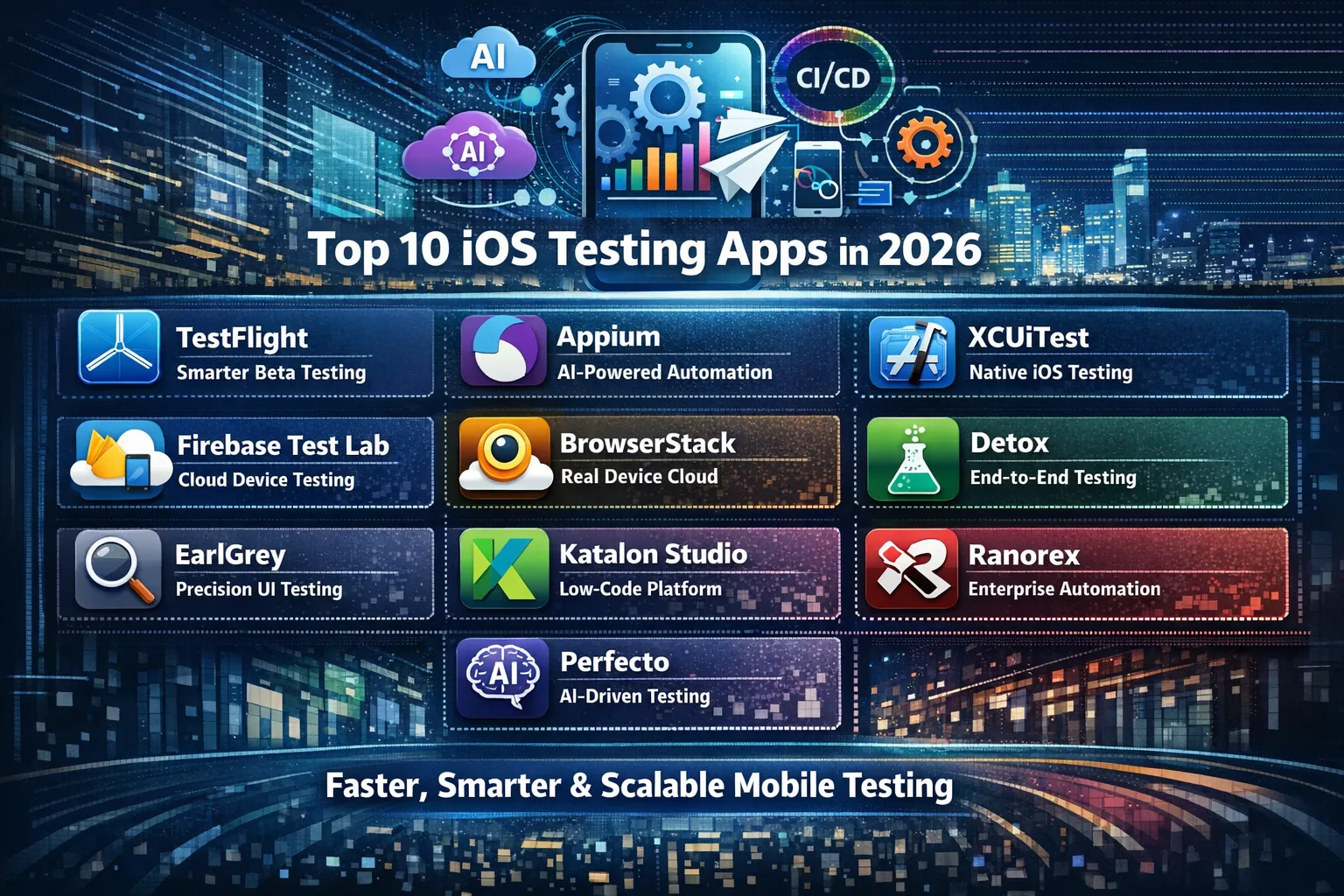
1. TestFlight – Smarter Beta Testing with Real User Insights
TestFlight remains the go-to platform for beta testing in the Apple ecosystem, but in 2026 it has evolved with improved analytics and smarter feedback systems.
Key Features
- Large-scale beta testing with real users
- Enhanced crash analytics
- User behavior tracking
- Seamless integration with App Store Connect
Why It Matters in 2026
User feedback is now data-driven. TestFlight allows developers to detect not only bugs but also usability issues before launch, helping improve retention rates.
2. Appium – AI-Enhanced Cross-Platform Automation
Appium continues to dominate automation testing, now enhanced with AI-assisted scripting and smarter element detection.
Key Features
- Cross-platform (iOS & Android)
- AI-assisted test creation
- Reusable test scripts
- CI/CD pipeline integration
Why It Matters in 2026
With shorter development cycles, automation is critical. Appium reduces manual effort and adapts better to UI changes using AI.
3. XCUITest – High-Performance Native Testing
XCUITest remains Apple’s core testing framework, now optimized for speed and reliability in complex apps.
Key Features
- Deep integration with Xcode
- Fast execution on real devices
- Improved debugging tools
- UI and performance testing
Why It Matters
For developers focused purely on iOS, XCUITest provides unmatched performance and stability.
4. Firebase Test Lab – Scalable Cloud Testing
Firebase Test Lab continues to expand its device coverage and automation capabilities.
Key Features
- Real device cloud testing
- Parallel test execution
- Integration with Firebase ecosystem
- Detailed logs and reports
Why It Matters
Cloud testing eliminates hardware limitations and allows testing at scale, which is essential in 2026.
5. BrowserStack – Instant Access to Real Devices
BrowserStack remains a top choice for testing across multiple devices and OS versions.
Key Features
- Thousands of real devices
- No setup required
- Live testing and automation
- Debugging tools
Why It Matters
Device fragmentation continues to grow, making platforms like BrowserStack crucial for compatibility testing.
6. Detox – Reliable End-to-End Testing
Detox is increasingly popular for modern app frameworks like React Native.
Key Features
- Fast and stable test execution
- Automatic synchronization
- End-to-end testing
- Developer-friendly setup
Why It Matters
In 2026, app complexity requires reliable E2E testing, and Detox minimizes flaky test results.
7. EarlGrey – Precision UI Testing
EarlGrey remains a strong option for UI testing with high reliability.
Key Features
- Automatic UI synchronization
- Clear error reporting
- Integration with Xcode
- Stable execution
Why It Matters
UI consistency is critical for user experience, and EarlGrey ensures accurate UI validation.
8. Katalon Studio – Low-Code Testing Platform
Katalon Studio continues to grow as a low-code testing solution.
Key Features
- Easy-to-use interface
- Supports mobile, web, and API testing
- Built-in automation tools
- CI/CD integration
Why It Matters
In 2026, low-code solutions help teams accelerate testing without requiring deep programming skills.
9. Ranorex – Advanced Automation for Enterprises
Ranorex remains a powerful tool for enterprise-level testing.
Key Features
- Advanced automation capabilities
- Drag-and-drop test creation
- Detailed reporting
- DevOps integration
Why It Matters
Large teams benefit from Ranorex’s scalability and advanced analytics.
10. Perfecto – AI-Driven Enterprise Testing
Perfecto leads the trend of AI-powered testing platforms in 2026.
Key Features
- AI-driven test insights
- Real and virtual devices
- Performance monitoring
- Automated and manual testing
Why It Matters
AI helps identify patterns, predict failures, and optimize testing strategies, making Perfecto ideal for large-scale applications.
Conclusion
In 2026, mobile app testing is no longer just about finding bugs—it’s about ensuring performance, scalability, and user satisfaction. With the rise of AI and cloud technologies, developers must adopt smarter tools to keep up with the fast-paced development environment.